
 By admin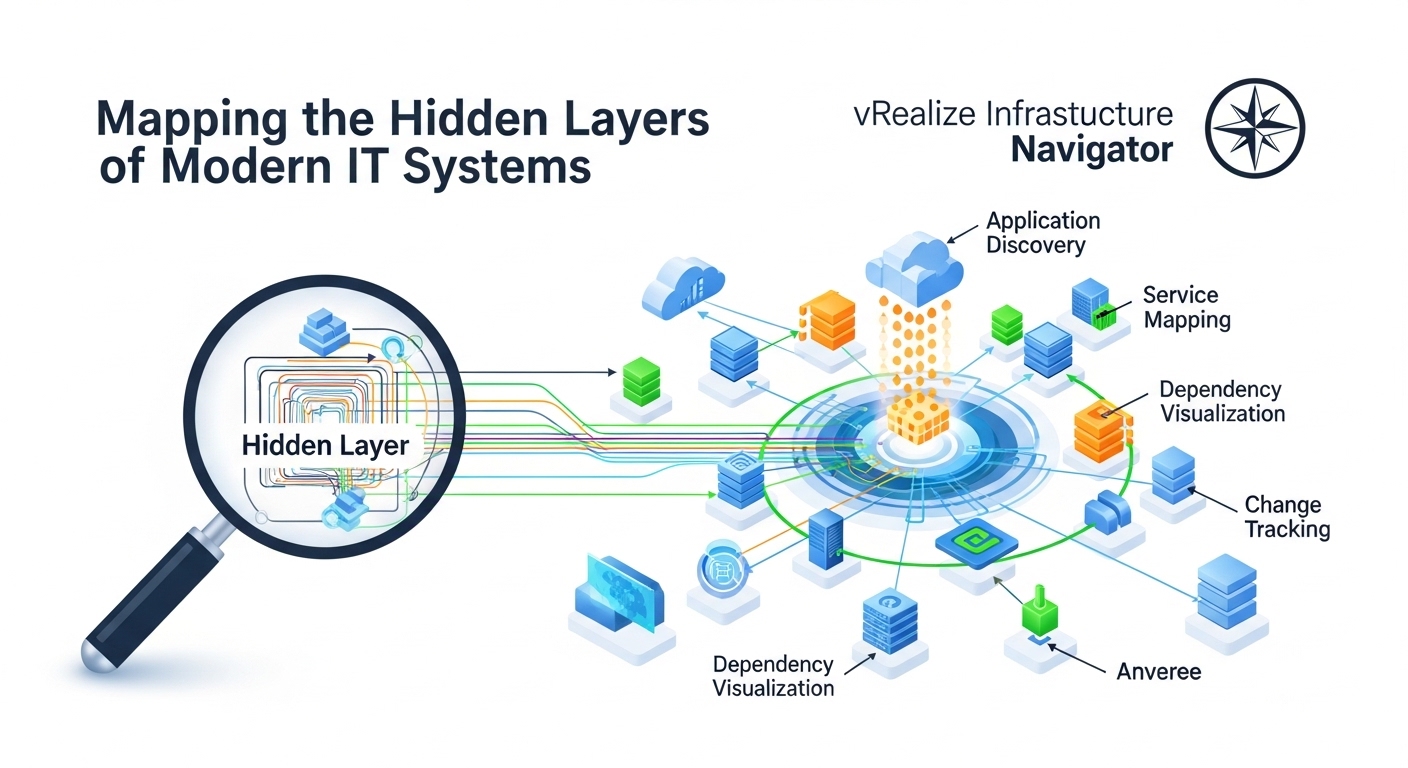
Late on a Friday evening, an IT operations team gathers around a dashboard, trying to trace the source of a sudden application slowdown. Servers appear healthy, network latency seems normal, and yet something is clearly wrong. The issue isn’t obvious because the system itself is complex—layers of applications, virtual machines, and dependencies intertwined in ways that are difficult to visualize.
This is precisely the kind of challenge that vRealize Infrastructure Navigator was designed to solve.
Developed as part of the broader virtualization ecosystem by VMware, vRealize Infrastructure Navigator helps organizations understand how their applications are connected across virtual environments. It brings visibility to what is often hidden—application dependencies, communication paths, and system relationships that are critical for performance and reliability.
For entrepreneurs, tech leaders, and founders navigating the world of cloud computing and infrastructure, tools like vRealize Infrastructure Navigator reveal an important truth: managing modern systems is not just about hardware or software—it’s about understanding how everything works together.
The Complexity of Modern IT Infrastructure
Today’s IT environments are vastly different from those of the past.
In traditional setups, applications were often tied to specific physical servers. Dependencies were easier to track because systems were relatively static.
But with the rise of virtualization, cloud computing, and microservices architecture, infrastructure has become dynamic and distributed.
Applications now run across multiple virtual machines, containers, and cloud services. They communicate with databases, APIs, and third-party systems in real time.
This complexity makes it difficult to answer simple questions:
Which components does this application rely on?
What happens if a specific server fails?
Where is a performance bottleneck occurring?
Without clear visibility, troubleshooting becomes time-consuming and risky.
That’s where vRealize Infrastructure Navigator steps in.
What Is vRealize Infrastructure Navigator?
vRealize Infrastructure Navigator is a tool designed to automatically discover and map application dependencies within virtualized environments.
It works by analyzing how different components of an application interact with each other. Instead of relying on manual documentation or guesswork, the tool provides a visual representation of these relationships.
This allows IT teams to see which virtual machines are connected, what services they are running, and how data flows between them.
By transforming complex systems into understandable maps, the tool helps organizations manage infrastructure more effectively.
For businesses operating at scale, this visibility is invaluable.
Why Dependency Mapping Matters
One of the most powerful aspects of vRealize Infrastructure Navigator is its ability to map dependencies automatically.
In modern IT systems, dependencies are everywhere. A single application might rely on a database, authentication service, external APIs, and multiple backend processes.
If one component fails, it can trigger a chain reaction that affects the entire system.
Dependency mapping helps teams understand these relationships before problems occur.
When an issue arises, teams can quickly identify which components are affected and prioritize their response.
This not only reduces downtime but also improves overall system resilience.
For startups and enterprises alike, the ability to visualize dependencies can mean the difference between rapid recovery and prolonged disruption.
How vRealize Infrastructure Navigator Works
At a high level, vRealize Infrastructure Navigator integrates with virtual environments to monitor communication between applications and services.
It observes traffic patterns and identifies which systems are interacting with each other. Based on this data, it builds a map of application dependencies.
This map is typically presented through an intuitive interface, allowing users to explore relationships visually.
Instead of reading through logs or analyzing raw data, teams can see connections at a glance.
This shift from data-heavy analysis to visual understanding represents a major improvement in how infrastructure is managed.
It aligns with a broader trend in technology: making complex systems more accessible through better design.
Key Features of vRealize Infrastructure Navigator
To understand its practical value, it’s helpful to look at the core capabilities of vRealize Infrastructure Navigator.
| Feature | Description | Benefit |
|---|---|---|
| Application Discovery | Automatically identifies running applications | Saves time and effort |
| Dependency Mapping | Visualizes relationships between components | Improves troubleshooting |
| Real-Time Monitoring | Tracks interactions as they happen | Enables faster response |
| Integration with Virtual Environments | Works within VMware ecosystems | Seamless deployment |
| Simplified Visualization | Converts complex data into clear diagrams | Enhances decision-making |
These features combine to create a tool that simplifies one of the most challenging aspects of IT management.
Use Cases in Real-World Environments
The practical applications of vRealize Infrastructure Navigator extend across various industries.
In enterprise environments, it helps IT teams manage large-scale systems with thousands of virtual machines.
In cloud-based startups, it provides clarity as systems grow rapidly and become more complex.
For example, during a system upgrade, teams can use dependency maps to understand which components may be affected.
During incident response, the tool helps identify the root cause of issues more quickly.
Even in compliance and security scenarios, understanding application relationships can help organizations assess risk and maintain control over their systems.
These use cases highlight the versatility of the tool.
The Strategic Value for Entrepreneurs and Founders
For entrepreneurs and founders, tools like vRealize Infrastructure Navigator offer more than operational benefits—they provide strategic advantages.
As businesses scale, their infrastructure becomes more complex. Without proper visibility, this complexity can slow down innovation and increase risk.
By investing in tools that provide clarity, companies can make better decisions about architecture, scaling, and resource allocation.
This is particularly important for startups transitioning from small systems to enterprise-level operations.
Understanding infrastructure is no longer just a technical requirement—it’s a business necessity.
Challenges and Considerations
While vRealize Infrastructure Navigator offers significant advantages, it is not without limitations.
Organizations must ensure that the tool is properly configured and integrated into their existing systems.
There may also be learning curves associated with interpreting dependency maps and understanding how to act on the insights provided.
Additionally, as IT environments evolve toward containerization and cloud-native architectures, organizations must evaluate how such tools fit into their broader technology stack.
Despite these challenges, the benefits of improved visibility often outweigh the initial effort required to implement the solution.
The Future of Infrastructure Visibility
The role of tools like vRealize Infrastructure Navigator is likely to expand as technology continues to evolve.
With the rise of artificial intelligence and automation, future systems may not only map dependencies but also predict potential failures before they occur.
Real-time analytics could provide deeper insights into performance and user behavior.
Meanwhile, the growing adoption of hybrid and multi-cloud environments will increase the need for comprehensive visibility across different platforms.
In this context, infrastructure navigation tools will become even more critical.
They will serve as the foundation for managing increasingly complex digital ecosystems.
Conclusion: Seeing the Invisible
In the world of modern IT, complexity is inevitable. Systems grow, dependencies multiply, and interactions become harder to track.
What tools like vRealize Infrastructure Navigator offer is something invaluable: visibility.
By turning invisible connections into clear, actionable insights, they empower teams to manage infrastructure with confidence.
For entrepreneurs and technology leaders, this visibility is not just a technical advantage—it is a competitive one.
In an era where digital systems drive business success, understanding how those systems work together is essential.
And sometimes, the key to that understanding is simply being able to see what was once hidden.