
 By admin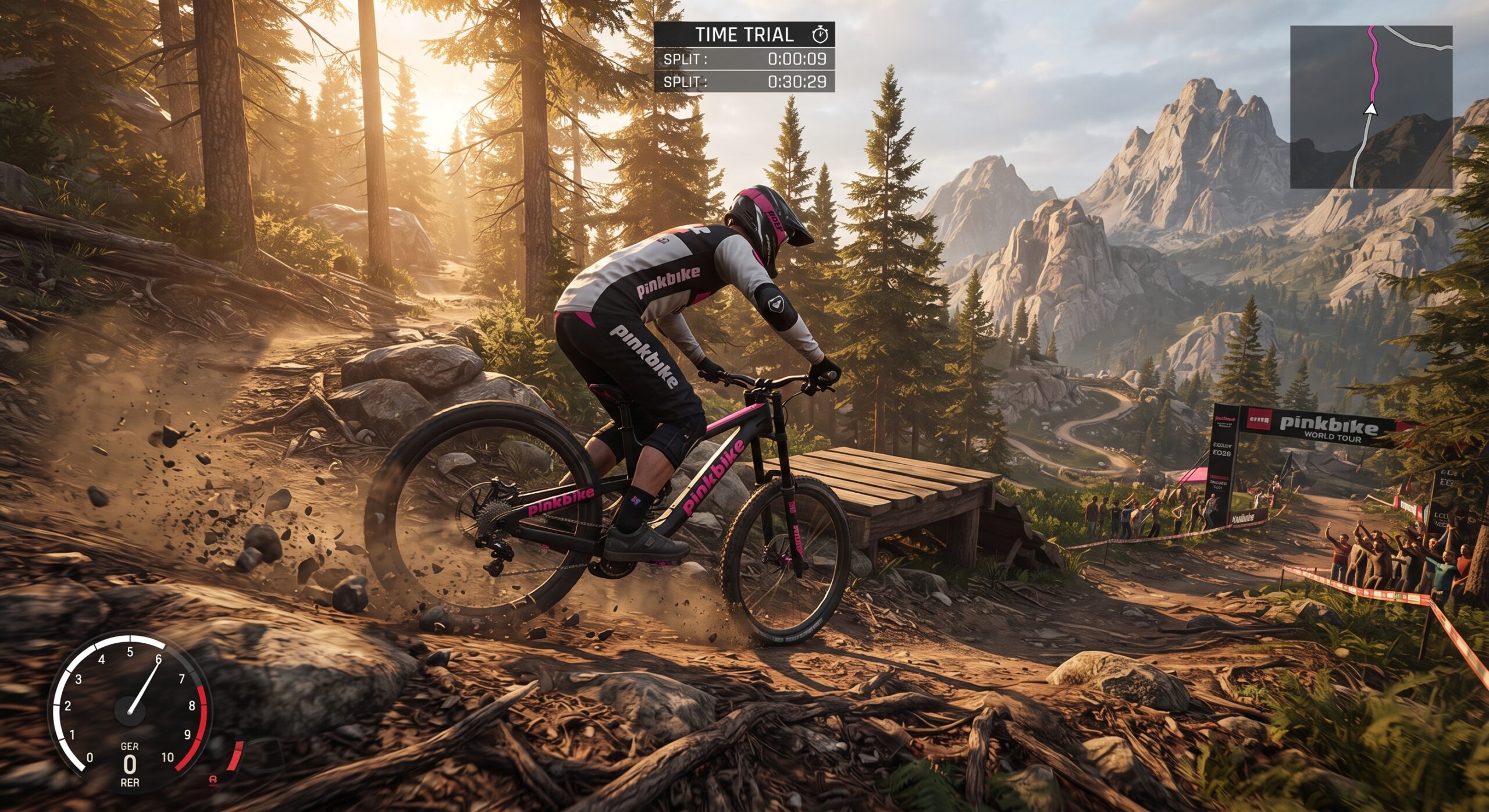
There was a time when mountain biking and video games seemed like an awkward combination. Riding a real trail depends on balance, terrain, speed, body position, and split-second decisions—things that are difficult to reproduce with a controller. Yet the growing interest around the pinkbike game concept shows how much the relationship between mountain biking and gaming has evolved.
Pinkbike itself is primarily a mountain-bike media and community platform rather than a single standalone video game. Its coverage includes racing, bike technology, videos, community content, and gaming-related stories. The phrase “Pinkbike game” can therefore refer to games associated with the Pinkbike audience, mountain-bike games discussed by Pinkbike, or newer titles inspired by the culture surrounding the sport.
That distinction matters because mountain-bike gaming has developed into a surprisingly diverse category.
What Does “Pinkbike Game” Actually Mean?
Unlike a traditional game franchise with one official title, the term pinkbike game is better understood as a search phrase connected with mountain-bike gaming and the wider Pinkbike community.
Pinkbike has published coverage of several games and gaming projects. One notable example is Descenders, a downhill mountain-bike game developed by RageSquid. Pinkbike reported that the game had surpassed four million players and highlighted its procedurally generated tracks, high-speed downhill riding, jumps, and tricks.
There have also been other forms of interactive entertainment connected with the mountain-bike community. Pinkbike previously covered SEND IT!, a mountain-biking board game that later introduced an online version through Tabletopia.
So when someone searches for a pinkbike game, they may actually be looking for an MTB game that captures the same excitement found in real mountain biking.
Why Mountain-Biking Games Are Different
The appeal of mountain-bike games comes from their ability to turn a complicated physical sport into something accessible.
A real downhill rider has to think about braking points, lines, jumps, terrain changes, traction, and body movement. A game simplifies those decisions while preserving the sensation of speed and risk.
Descenders is a good example. Instead of sending players through only predetermined courses, its tracks are procedurally generated, meaning the riding environment can change from one run to another. That gives the experience a strong replay factor because learning one route does not necessarily mean mastering the next.
This is particularly interesting for gamers who enjoy challenge-based progression. Every run becomes an opportunity to improve timing, control, and decision-making.
The Evolution of MTB Gaming
Mountain-bike gaming has had several different eras. Earlier titles generally focused on arcade-style action, exaggerated jumps, and spectacular tricks. Modern games have increasingly experimented with physics, procedural environments, customization, and more specialized riding mechanics.
| Era | Main Focus | Typical Experience |
|---|---|---|
| Early MTB games | Arcade action | Fast riding and exaggerated tricks |
| Transitional era | Console & PC experimentation | Racing, downhill and freestyle |
| Modern MTB games | Physics and replayability | Technical riding and procedural tracks |
| New niche titles | Community-driven experiences | Challenges, tricks and MTB culture |
This evolution reflects a broader change in sports gaming. Players increasingly expect games to provide not just a collection of levels but systems that allow them to develop their own style.
The Rise of The Grim Donut Game
One of the more unusual recent examples connected with the Pinkbike universe is The Grim Donut Game.
The game is built around the infamous Grim Donut mountain-bike prototype associated with Pinkbike. Available information describes a gameplay structure involving 10 levels and 45 challenges, with players riding through environments inspired by British Columbia trails. It also features a trick system designed around speed, timing, combinations, and style.
The concept is interesting because it takes something that began as a distinctive piece of mountain-bike culture and transforms it into an interactive experience.
Rather than simply recreating a generic bicycle, the game gives the bike and its surrounding personality a central role.
Why These Games Appeal to Mountain Bikers
The strongest mountain-bike games understand that riders are not interested only in winning races.
For many riders, the attraction is the line itself.
A rider might replay the same section because a jump felt perfect, a corner was taken faster, or a landing finally worked. Good MTB games can reproduce that same loop: attempt, fail, adjust, and try again.
That makes the genre particularly appealing to people who enjoy mastery-based games.
It also creates an unusual bridge between real-world athletes and gamers. Someone who already rides can recognize concepts such as line choice and timing, while someone unfamiliar with mountain biking can gradually learn why those decisions matter.
Can a Mountain-Bike Game Replace Real Riding?
Not really—and that is part of the appeal.
A game cannot reproduce the physical sensation of riding a real bike down a rough trail. It cannot recreate the vibration through the handlebars, changing weather, physical fatigue, or the consequences of a genuine mistake.
What gaming can provide is a safe environment for experimentation.
Players can attempt enormous jumps, explore difficult terrain, and repeatedly practice challenging sequences without the physical risks associated with real riding. This makes gaming complementary to the sport rather than a replacement for it.
What Makes a Good MTB Game?
The best examples tend to balance three elements: control, challenge, and freedom.
Controls need to feel predictable enough that players understand why they succeeded or failed. Challenge needs to increase without becoming frustrating. And freedom gives players the ability to approach a section differently rather than simply following one predetermined solution.
That last element is especially important for mountain biking. Real riders develop individual preferences for speed, lines, jumps, and technical sections. A good game should leave enough room for that personality to emerge.
The Future of Mountain-Bike Gaming
The future could be particularly interesting as game physics, procedural generation, mobile hardware, and controller technology continue improving.
Mountain biking is naturally suited to games because it combines speed, exploration, technical decision-making, and risk. Developers do not necessarily need to create a massive open-world experience to make the concept work. A compact game with excellent physics and satisfying progression can be enough.
The continuing attention around games such as Descenders demonstrates that there is an audience for this specialized genre. Meanwhile, projects connected to recognizable MTB culture show that games can also build directly on the personalities, bikes, and ideas that riders already know.
Final Thoughts
The pinkbike game search is really part of a bigger story: mountain biking has become more than a physical sport. It is a culture that now extends into media, competitions, online communities, technology, and gaming.
Whether players discover mountain biking through an arcade-style title, a physics-focused downhill game, or a quirky project such as The Grim Donut Game, the underlying attraction remains the same—the feeling of finding a line, committing to it, and trying to ride it perfectly.
For developers, that creates a powerful opportunity. The next great mountain-bike game does not necessarily need more bikes or bigger maps. It needs to understand why people love riding in the first place.