
 By admin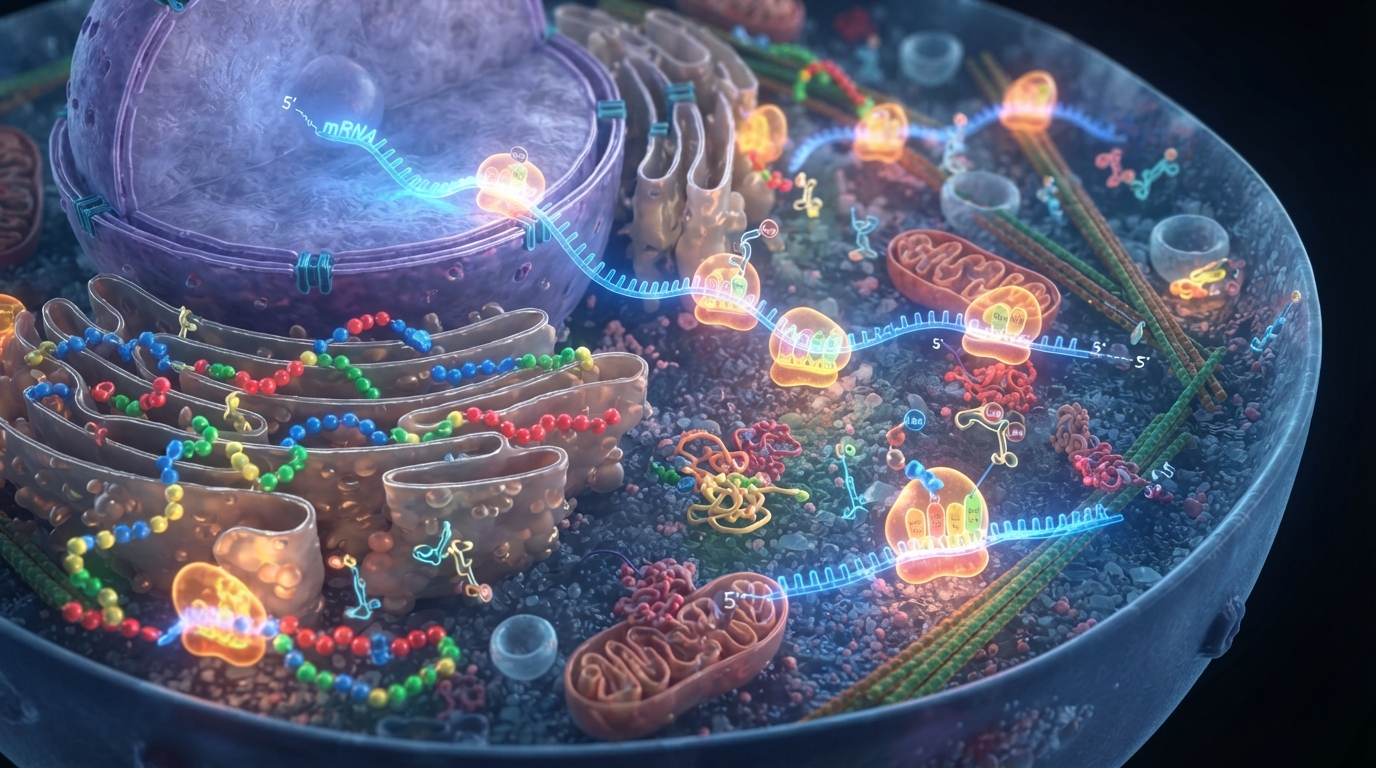
Every second, trillions of microscopic processes unfold inside the human body without attracting the slightest attention. A cut on your finger begins to heal. Your muscles recover after exercise. Your brain forms new memories while you sleep. Behind each of these remarkable events lies an invisible workforce of cells tirelessly building the proteins that make life possible.(where does translation occur)
Imagine a bustling factory where blueprints arrive from a central office, machines assemble products with astonishing precision, and every component is delivered exactly when needed. This is remarkably similar to what happens inside every living cell. DNA stores the master instructions, messenger RNA carries those instructions, and another specialized location transforms genetic information into functional proteins.
This naturally raises one of biology’s most important questions: where does translation occur? Understanding the answer offers insight into everything from human growth and immune defense to modern medicine and biotechnology. Translation is far more than a textbook concept—it is one of life’s essential processes, connecting genetic information to the molecules that keep organisms alive.
What Is Translation in Biology?
Translation is the biological process through which cells convert the genetic instructions carried by messenger RNA (mRNA) into proteins. These proteins perform nearly every task necessary for life, including building tissues, catalyzing chemical reactions, transporting molecules, and defending against disease.
The name “translation” is fitting because the cell effectively translates one biological language into another. The sequence of nucleotides in mRNA is interpreted as a sequence of amino acids, which are linked together to form proteins.
Translation follows transcription, the earlier process in which DNA is copied into messenger RNA. Together, transcription and translation form the central pathway through which genetic information becomes biological function.
Without translation, the instructions stored within DNA would remain unread, much like a recipe that never reaches the kitchen.
Where Does Translation Occur?
The answer depends on the type of cell, but the central location remains the same: translation occurs on ribosomes.
Ribosomes are specialized molecular structures responsible for reading messenger RNA and assembling proteins one amino acid at a time. They function as incredibly efficient protein-building machines, capable of producing thousands of different proteins based on genetic instructions.
In eukaryotic cells, including those of humans, animals, and plants, translation occurs in two primary locations:
| Cell Type | Where Translation Occurs | Function |
|---|---|---|
| Eukaryotic cells | Free ribosomes in the cytoplasm | Produce proteins used inside the cell |
| Eukaryotic cells | Ribosomes attached to the rough endoplasmic reticulum | Produce proteins for secretion, membranes, or specialized organelles |
| Prokaryotic cells | Ribosomes floating in the cytoplasm | Produce all cellular proteins because no membrane-bound organelles exist |
Although the exact cellular environment differs, ribosomes remain the universal site of translation across all known forms of life.
Why Ribosomes Are the Cell’s Protein Factories
Ribosomes may appear simple under a microscope, but they are among the most sophisticated molecular machines found in nature.
Each ribosome consists of two subunits composed of ribosomal RNA (rRNA) and proteins. These subunits come together when messenger RNA arrives carrying genetic instructions.
As the ribosome moves along the mRNA strand, it reads groups of three nucleotides called codons. Every codon specifies a particular amino acid.
Transfer RNA (tRNA) molecules serve as delivery vehicles, bringing the correct amino acids to match each codon. The ribosome joins these amino acids together with peptide bonds, gradually constructing a complete protein.
This entire process is astonishingly accurate. Cellular proofreading mechanisms help ensure that proteins are assembled with remarkable precision, minimizing potentially harmful errors.
Translation in Eukaryotic Cells
Eukaryotic cells possess internal compartments that allow protein production to be highly organized.
Free Ribosomes
Many ribosomes float freely throughout the cytoplasm. These free ribosomes manufacture proteins that remain inside the cell, where they perform essential internal functions.
Examples include enzymes involved in metabolism, structural proteins that maintain cell shape, and proteins needed within the nucleus or mitochondria.
Because these proteins stay within the cell, they do not require additional transport through specialized cellular pathways.
Rough Endoplasmic Reticulum
Other ribosomes attach themselves to the rough endoplasmic reticulum (RER), a network of folded membranes surrounding the nucleus.
The rough appearance comes directly from the thousands of ribosomes attached to its surface.
These ribosomes produce proteins destined for export from the cell, insertion into cell membranes, or delivery to organelles such as lysosomes.
Once synthesized, proteins enter the interior of the rough endoplasmic reticulum, where they begin folding into their proper shapes before moving through the Golgi apparatus for further processing and distribution.
This highly coordinated production line enables cells to manufacture complex proteins efficiently while directing each one to its correct destination.
Translation in Prokaryotic Cells
Prokaryotic organisms, including bacteria, have a much simpler cellular structure.
Unlike eukaryotic cells, they lack a nucleus and membrane-bound organelles. Their DNA resides directly within the cytoplasm, allowing transcription and translation to occur almost simultaneously.
As messenger RNA is being synthesized, ribosomes can immediately begin translating it into protein. This coupling enables bacteria to respond rapidly to environmental changes.
The speed of this system gives prokaryotes an evolutionary advantage, allowing them to adapt quickly when nutrients become available or environmental conditions shift.
Although structurally simpler than eukaryotic cells, prokaryotic translation remains highly efficient and remarkably effective.
The Three Stages of Translation
Translation proceeds through three carefully coordinated stages.
Initiation
The process begins when the small ribosomal subunit binds to messenger RNA near its starting point.
A special initiator transfer RNA carrying the amino acid methionine recognizes the start codon, typically AUG.
The large ribosomal subunit then joins the complex, creating a fully functional ribosome ready to build the protein.
Elongation
During elongation, the ribosome moves steadily along the messenger RNA.
Each new codon recruits a matching transfer RNA carrying its corresponding amino acid.
The ribosome forms peptide bonds between neighboring amino acids, extending the growing protein chain one building block at a time.
This cycle repeats rapidly, often adding several amino acids every second.
Termination
Eventually, the ribosome encounters a stop codon.
Unlike ordinary codons, stop codons do not correspond to an amino acid.
Instead, release factors bind to the ribosome, signaling that protein synthesis is complete.
The newly formed protein is released, the ribosomal subunits separate, and the messenger RNA may be translated again by additional ribosomes.
Why the Location of Translation Matters
Knowing where translation occurs helps explain many fundamental aspects of biology and medicine.
Proteins synthesized on free ribosomes generally remain within the cell, while proteins produced on ribosomes attached to the rough endoplasmic reticulum often become hormones, digestive enzymes, antibodies, or membrane proteins.
This distinction ensures that proteins arrive precisely where they are needed.
Modern medicine also relies heavily on understanding translation.
Many antibiotics work by targeting bacterial ribosomes without affecting human ribosomes, allowing physicians to eliminate harmful bacteria while minimizing damage to the patient’s own cells.
Similarly, several cutting-edge therapies, including mRNA-based vaccines, depend on the body’s ribosomes translating introduced messenger RNA into harmless proteins that stimulate protective immune responses.
Without the translation machinery functioning correctly, these medical innovations would not be possible.
Common Misconceptions About Translation
Students frequently confuse transcription and translation because both involve genetic information.
Transcription occurs when DNA is copied into messenger RNA. In eukaryotic cells, this process takes place inside the nucleus.
Translation occurs after transcription and happens on ribosomes located in the cytoplasm or attached to the rough endoplasmic reticulum.
Another misconception is that translation happens inside the nucleus. While DNA remains protected within the nucleus, protein synthesis itself takes place outside it after messenger RNA has exited through nuclear pores.
Recognizing this separation helps clarify how cells carefully regulate gene expression while protecting their genetic material.
Translation Beyond Human Cells
Translation is not unique to humans. Every known organism—from bacteria and fungi to plants and animals—relies on ribosomes to produce proteins.
Despite billions of years of evolution, the fundamental mechanism has remained remarkably consistent.
This universality highlights translation’s extraordinary importance. Scientists can study bacterial ribosomes to gain insights into basic biological principles that apply across countless species.
It also explains why biotechnology companies can engineer microorganisms to produce insulin, vaccines, industrial enzymes, and other valuable proteins using the same translation machinery found throughout life.
The Future of Translation Research
Advances in molecular biology continue to reveal new details about how ribosomes function.
Researchers are exploring how translation is regulated during development, aging, and disease. They are investigating how errors in protein synthesis contribute to conditions such as cancer and neurodegenerative disorders.
Emerging technologies are also enabling scientists to design synthetic messenger RNAs that direct cells to produce therapeutic proteins with unprecedented precision.
As our understanding grows, translation is becoming not only a cornerstone of biology education but also a driving force behind personalized medicine, gene therapy, and innovative treatments that were once considered impossible.
Conclusion
The question where does translation occur opens the door to one of biology’s most fascinating stories. Translation takes place on ribosomes, whether they float freely within the cytoplasm or attach to the rough endoplasmic reticulum in eukaryotic cells. In prokaryotes, ribosomes within the cytoplasm perform the same essential role.
More importantly, translation represents the moment when genetic information becomes biological reality. Every muscle contraction, immune response, heartbeat, and healing wound depends on proteins assembled through this remarkable cellular process.
As research continues to unlock new applications in medicine and biotechnology, translation remains far more than an academic concept. It is one of life’s most fundamental processes, silently powering every living organism and shaping the future of modern science.