
 By Hasnain Jamshaid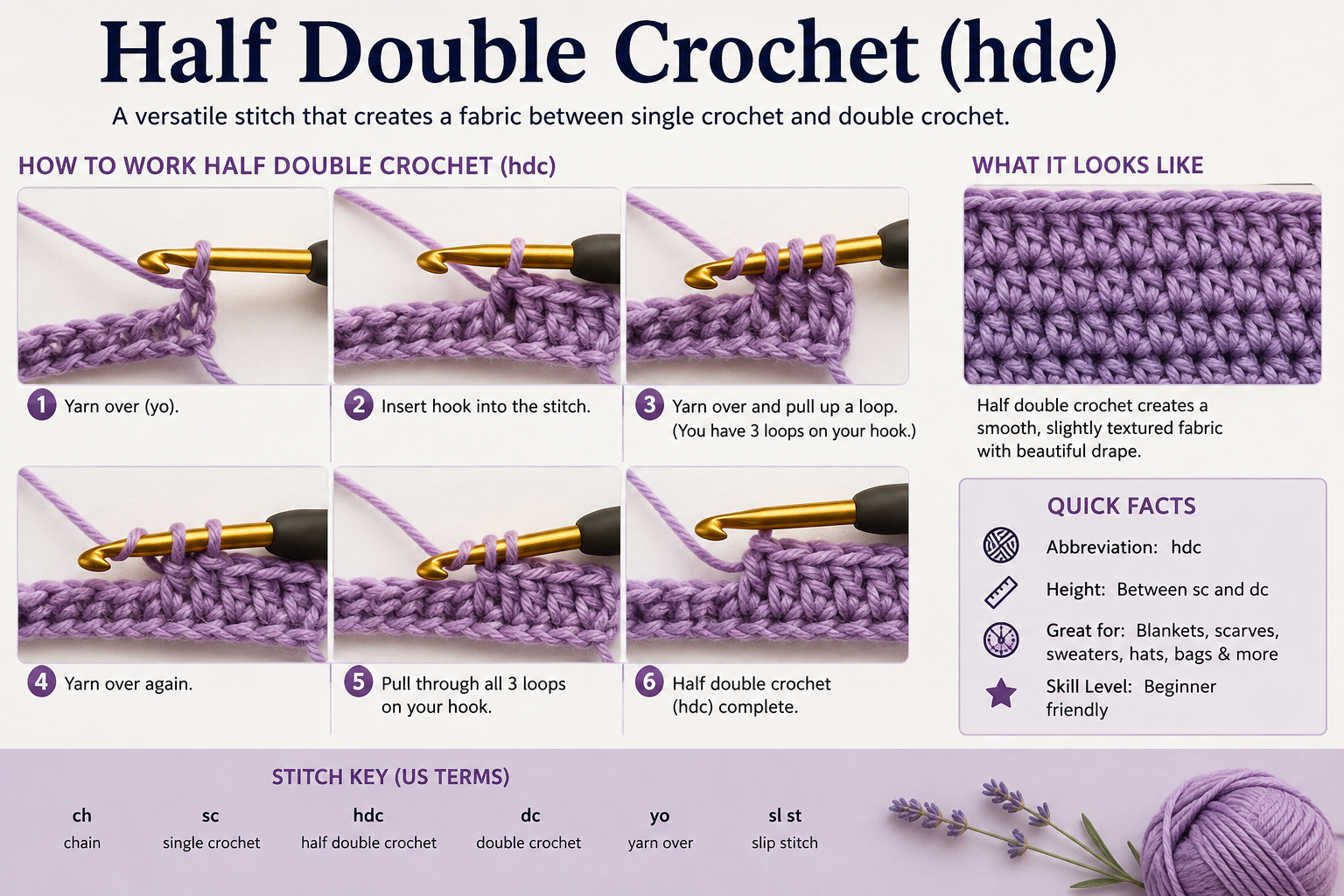
The first time a crocheter moves beyond the basic single crochet, there is often a moment of discovery. A new stitch can suddenly change the texture, speed, and personality of an entire project. Among the most useful of these is the half double crochet. It sits comfortably between the compact single crochet and the taller double crochet, offering a balance of height, softness, and structure that makes it remarkably versatile.
For beginners, this stitch is easy enough to learn without feeling overwhelming. For experienced crocheters, it is dependable enough to become a go-to technique for blankets, sweaters, hats, bags, scarves, and amigurumi details. Understanding how it works—and why it behaves differently from other basic stitches—can make crochet patterns easier to follow and designs easier to create.
What Is Half Double Crochet?
Half double crochet, commonly abbreviated as hdc, is a fundamental crochet stitch in US crochet terminology. It produces a fabric that is taller than single crochet but shorter than double crochet.
Its distinctive feature is that the yarn-over and pull-through process is completed in a single final movement. This gives the stitch a characteristic appearance: rows tend to look slightly more textured and substantial than single crochet while remaining more compact than double crochet.
The stitch is particularly useful when a project needs moderate height without becoming too open or loose. That middle-ground quality is what makes it so practical.
Why This Stitch Matters in Crochet
Crochet is largely about controlling three things: height, density, and texture. A single crochet creates a relatively dense fabric. A double crochet creates more height and openness. Half double crochet occupies the space between them.
That middle position has practical advantages.
When working a blanket, for example, using hdc can make the project grow faster than single crochet while retaining enough density to create a warm fabric. In garments, the stitch can provide comfortable drape without producing an excessively open fabric. In accessories such as hats and bags, it can add body while still giving the finished piece a softer appearance.
This balance also makes hdc valuable for designers who want a fabric that looks simple but does not feel flat.
How to Work Half Double Crochet
Once the basic motion is understood, the stitch becomes quite straightforward.
Begin by making a yarn over. Insert the hook into the designated stitch, then yarn over again and pull up a loop. At this point, there will be three loops on the hook.
Instead of pulling through two loops and then two again, as you would with a double crochet, yarn over once more and pull through all three loops at the same time.
That final movement is the defining characteristic of the stitch.
When working across a row, repeat the same process in each designated stitch. The result is a neat horizontal row of medium-height stitches.
Half Double Crochet vs. Single and Double Crochet
The easiest way to understand hdc is to compare it with the stitches surrounding it in height.
| Stitch | US Abbreviation | Relative Height | Fabric Character |
|---|---|---|---|
| Single crochet | sc | Short | Dense and firm |
| Half double crochet | hdc | Medium | Balanced and slightly textured |
| Double crochet | dc | Tall | More open and drapey |
The differences may seem small when looking at an individual stitch, but they become much more noticeable across dozens or hundreds of stitches.
A project made entirely with hdc often has a pleasing combination of structure and flexibility. It is not as stiff as dense single crochet, yet it generally does not have the openness associated with taller stitches.
The Importance of the Turning Chain
One detail that can cause confusion for newer crocheters is the turning chain.
Patterns vary in how they treat the turning chain for hdc. Some designers count the turning chain as a stitch, while others instruct crocheters to chain without counting it as one. Neither approach is inherently wrong, but consistency is essential.
If a pattern says that the turning chain counts as a stitch, the first actual hdc of the row may be worked into a later stitch. If the chain does not count, the first hdc is generally worked into the first appropriate stitch.
This is why crocheters should always follow the specific instructions of the pattern rather than automatically applying the same turning-chain rule to every project.
Understanding Where to Insert the Hook
Most basic crochet stitches are worked under the two top loops of the stitch unless a pattern specifies otherwise. These loops form the familiar “V” shape along the top edge of the fabric.
However, hdc can also be used creatively by inserting the hook into the front loop only, back loop only, or other designated spaces.
Changing the insertion point can dramatically alter the appearance of the finished fabric.
Working through the back loop, for instance, can create horizontal ridges that add visual texture. Front-loop work can produce another variation of raised lines. These techniques do not change the basic hdc motion; they simply change where the hook enters the fabric.
That distinction is important when reading advanced crochet patterns.
Maintaining Consistent Tension
Tension has a major influence on how hdc looks and behaves.
If the yarn is pulled extremely tightly, the finished fabric can become stiff and difficult to work into. If the loops are pulled too loosely, the fabric may become larger and more open than expected.
The goal is not necessarily to hold the yarn as tightly as possible. Instead, aim for consistent loop size and a comfortable rhythm.
Experienced crocheters often develop tension naturally through repetition. Beginners can help themselves by periodically checking whether their stitches are becoming noticeably tighter or looser as they work.
Consistency matters more than speed.
Half Double Crochet in Real Projects
One reason hdc remains popular is its usefulness across different categories of crochet.
For blankets and throws, it provides enough height to make progress at a reasonable pace while creating a cozy fabric. For scarves, it can produce a soft texture without excessive openness. Hats benefit from the stitch’s balance between stretch, density, and height.
It can also work well for sweaters, cardigans, baby items, home décor, and bags. The final result depends heavily on yarn weight, hook size, tension, and construction, but the underlying stitch remains remarkably adaptable.
For crochet designers, that versatility means hdc can function as both a main stitch and a supporting stitch within a larger pattern.
Texture Through Simple Variations
A basic hdc fabric does not have to look repetitive.
Changing colors between rows can create stripes. Alternating hdc with other stitches can produce visual patterns. Working stitches through particular loops can introduce ridges and lines. Combining different yarn textures can make the same stitch appear dramatically different.
This is one of the strengths of crochet: a relatively small collection of fundamental stitches can produce an enormous variety of finished designs.
Half double crochet is a particularly useful building block because its moderate height allows it to transition naturally between shorter and taller stitches.
Common Mistakes Beginners Make
The stitch itself is simple, but a few recurring mistakes can affect the finished fabric.
One common problem is accidentally skipping the first or last stitch of a row. This can gradually reduce the width of a project. Another is adding an extra stitch around the turning chain, which can make the project grow wider with every row.
Inconsistent tension is another frequent issue. A crocheter may begin a project with tight stitches and gradually loosen their grip, causing the rows to become larger.
The best defense is to count stitches regularly, especially during the first few rows of a new pattern. If a pattern specifies an exact stitch count, treat that number as an important checkpoint rather than an optional detail.
How to Improve Your Technique
The fastest way to become comfortable with hdc is repetition.
Start with a small practice swatch rather than immediately attempting a large blanket. Work several rows while paying attention to how the yarn moves through the three loops on the hook.
Then experiment with tension. Make one section tighter and another more relaxed. Observe how the fabric changes.
Once the basic movement feels natural, practice increasing and decreasing with hdc. These techniques are essential for shaping hats, garments, toys, and many other crochet projects.
Over time, the movement becomes almost automatic, allowing you to concentrate more on pattern reading and design.
A Small Stitch With a Big Role
Crochet often rewards attention to seemingly minor details. A difference of one stitch height can affect the drape of an entire garment. A small change in tension can alter the dimensions of a blanket. A different hook insertion point can transform a plain surface into a textured one.
Half double crochet demonstrates this perfectly.
It is neither the shortest nor the tallest of the common basic stitches, but that is precisely why it is useful. Its versatility comes from occupying the middle ground.
Conclusion: Mastering the Middle Ground
Half double crochet may not have the instant visual drama of elaborate crochet techniques, but its value lies in reliability. It is quick enough for larger projects, substantial enough for practical fabrics, and flexible enough for countless designs.
For beginners, mastering hdc is an important step toward understanding how stitch height influences crochet fabric. For experienced makers, it remains a dependable tool that can solve problems of texture, density, and speed.
The most useful crochet stitches are often not the fanciest ones. They are the stitches that give a designer control. Half double crochet is one of those stitches—a simple technique that quietly expands what a crocheter can make.